


As the world watches the Vatican with bated breath, the question on everyone’s lips is: who’ll don the papal tiara next? With Pope Francis steering the ship toward 2025, speculation is swirling faster than a priest at a bingo night. Will the next pontiff be a familiar face or a surprise contender?
Understanding the Papacy
The papacy stands as a pivotal religious office within the Catholic Church. Speculation about the next pope intensifies as Pope Francis nears 2025.
The Role of the Pope
The pope serves as the spiritual leader of over 1.3 billion Catholics worldwide. This individual guides the church’s doctrine and administers its various functions. He also represents the Vatican in diplomatic matters. Furthermore, the pope provides leadership during crises and advocates for social justice. He embodies the unity of the Catholic faith through his teachings and actions. His influence extends beyond religious boundaries, shaping moral and ethical discussions globally.
Historical Significance of the Position
The papacy traces its history back to St. Peter, one of Jesus’ apostles. This lineage emphasizes the continuity of the Catholic faith over centuries. Several pivotal moments in history define the papacy, such as the Reformation and the establishment of Vatican City as an independent state. Popes have played crucial roles in peace negotiations, education, and social reform. Their actions often reflect broader societal changes and challenges. This historical significance underscores the pope’s influence on both church and world affairs.
Current Pope’s Tenure
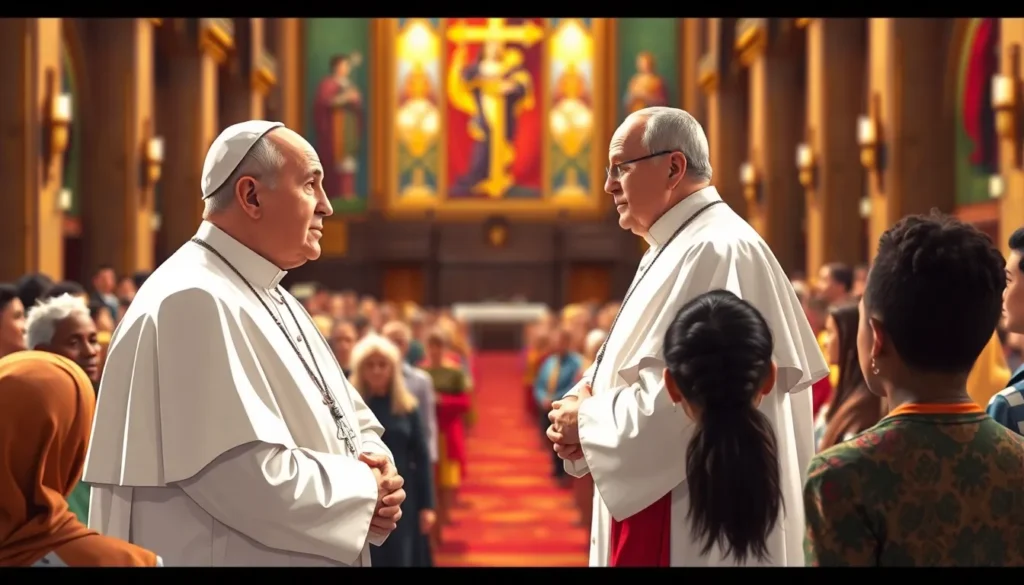
Pope Francis has led the Catholic Church since March 13, 2013. His tenure has been marked by significant achievements and various challenges.
Overview of Pope Francis’ Achievements
Pope Francis focused on interfaith dialogue and noted advancements in relations with other Christian denominations. He initiated the encyclical “Laudato Si’,” emphasizing environmental stewardship as a moral imperative. His commitment to social issues, including poverty and migration, positioned the Church as a proactive voice for justice. Encouraging synodality has reshaped church governance and promoted inclusivity within the Catholic community. Enhancements in the visibility and outreach of the Church reflect his dedication to modernization and relevance.
Challenges Faced by Pope Francis
Pope Francis encountered numerous challenges during his papacy. The COVID-19 pandemic tested the Church’s ability to adapt to new realities and maintain congregational engagement. He also addressed clerical sexual abuse scandals, which challenged the Church’s credibility and necessitated systemic reforms. Resistance from conservative factions within the Church complicated his efforts toward progressive changes. Political tensions and global crises further strained his leadership, underscoring the complexity of his role as a spiritual leader.
Potential Candidates for Pope in 2025
Speculation about the next pope focuses on several prominent figures within the Catholic Church. Key candidates include established Cardinals with significant influence.
Cardinal Luis Antonio Tagle
Cardinal Luis Antonio Tagle, the former Archbishop of Manila, holds considerable rapport within the church. His emphasis on pastoral care and social justice resonates globally. Tagle’s work with marginalized communities showcases his commitment to addressing critical issues. Known for his ability to connect with youth, he could attract a younger demographic. His previous role as head of the Vatican’s Congregation for the Evangelization of Peoples amplifies his international presence and understanding of diverse cultures.
Cardinal Peter Turkson
Cardinal Peter Turkson, the current Prefect of the Dicastery for Promoting Integral Human Development, emphasizes themes of social justice and climate change. His background in environmental issues aligns with Pope Francis’ teachings from “Laudato Si’”. Turkson has advocated for global development, focusing on the moral implications of economic inequality. His experience leading discussions on sustainable development gives him a unique perspective. His strong communication skills enable him to engage effectively in interfaith dialogue, broadening his appeal beyond Catholicism.
Other Notable Contenders
Other notable contenders include Cardinal Matteo Zuppi, the Archbishop of Bologna, and Cardinal Robert Sarah from Guinea. Zuppi’s leadership during Italy’s COVID-19 response demonstrates his pastoral approach. His focus on reconciliation and unity addresses pressing societal divisions. Sarah, known for his conservative views, appeals to traditionalist factions within the church. His tenure as Prefect for the Congregation for Divine Worship provides him with extensive liturgical knowledge. Additionally, Cardinals such as Joseph Tobin and Juan Espinoza could emerge as influential figures, further shaping the landscape of papal candidates.
Factors Influencing the Selection
Multiple factors affect the selection of the next pope, reflecting the interplay between global events and internal church dynamics.
The Impact of Global Affairs
Global affairs significantly shape the papal selection process. Issues such as climate change, migration, and social justice offer pressing concerns for the Catholic Church. The current geopolitical landscape requires a leader who addresses these global challenges. Emerging nations, particularly in regions with growing Catholic populations, may advocate for candidates aligned with their perspectives. Additionally, conversations around ecumenism and interfaith dialogue play a role in determining suitable candidates. Various socio-political climates influence the church’s outreach and priorities, reflecting the importance of a pope’s adaptability to contemporary issues.
The Role of the Vatican Conclave
The Vatican Conclave serves as the body responsible for electing a new pope. Cardinals from around the world convene in secrecy to deliberate and vote. It’s essential that the conclave considers candidates with a global outlook and ability to unify diverse church factions. Each cardinal brings unique perspectives informed by their experiences and the challenges faced within their dioceses. The voting process, based on a two-thirds majority requirement, encourages consensus building among cardinals. In this environment, the conclave balances tradition with the need for innovation in the papacy, impacting the selection of the next spiritual leader.
Speculations and Predictions
Speculations surrounding the next pope in 2025 spark intense interest. Various factors shape these predictions, ranging from global challenges to internal church dynamics.
Expert Opinions on Future Leadership
Experts emphasize the need for a pope who can navigate contemporary issues like climate change and social justice. Cardinal Luis Antonio Tagle frequently comes up in conversations due to his strong advocacy for these causes. Furthermore, Cardinal Peter Turkson also garners attention, especially for his experience and alignment with Pope Francis’ vision. Scholars argue that the new pope must maintain unity among diverse factions within the church while promoting innovative approaches. Additionally, insights from analysts highlight the significance of pastoral experience in selecting the future leader, indicating that this quality can resonate with a global Catholic audience.
Public Sentiment and Expectations
Public sentiment reflects a desire for a leader who prioritizes inclusivity and social justice. Many Catholics express hope for a successor who embodies the compassionate teachings of Pope Francis. Discussions among the faithful often center on candidates like Cardinal Matteo Zuppi, known for his response to Italy’s COVID-19 crisis, and Cardinal Robert Sarah, appealing to traditional values. The expectation exists for the next pope to address pressing issues while remaining rooted in the church’s foundational teachings. Overall, the anticipation builds as the faithful look for leadership that resonates with contemporary moral challenges.
The anticipation surrounding the next pope in 2025 reflects the evolving landscape of the Catholic Church. As Pope Francis prepares to pass the torch the focus remains on candidates who can address pressing global issues while embodying the church’s core values. With figures like Cardinal Luis Antonio Tagle and Cardinal Peter Turkson at the forefront the selection process will undoubtedly shape the future direction of the papacy.
As the world watches the Vatican Conclave the hope for a leader who prioritizes social justice and inclusivity grows stronger. The next pope will not only inherit a rich legacy but also face the challenge of uniting a diverse global community. This pivotal moment in history will resonate far beyond the church as it seeks to navigate the complexities of modern society.


