
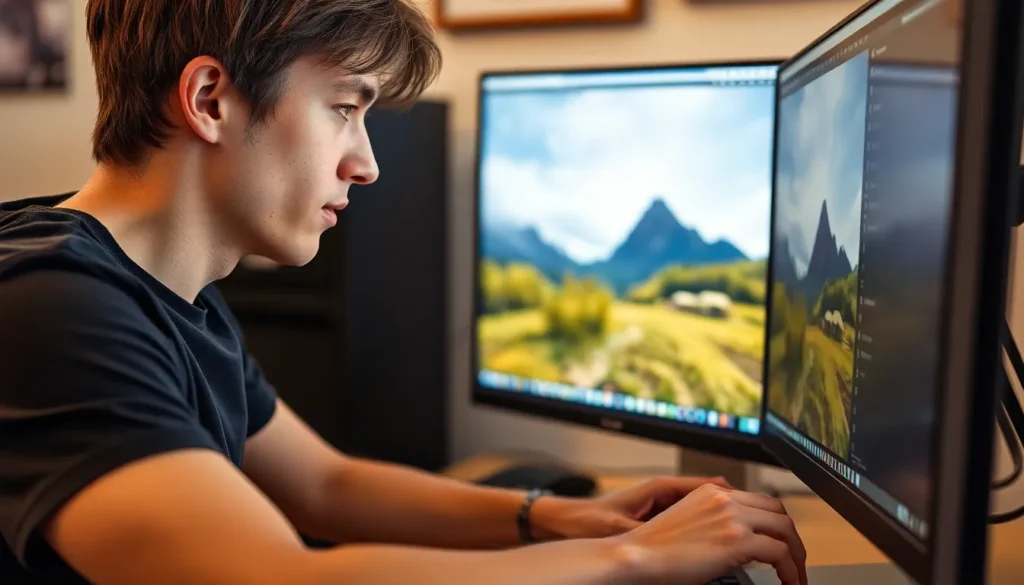

In a world where everyone’s a photographer, nothing’s worse than realizing that your stunning sunset shot looks like it was taken through a potato. Enter AI image upscaling, the superhero of the digital age. It swoops in to rescue those pixelated memories, transforming them into high-definition masterpieces faster than you can say “filter.”
Overview of AI Image Upscaling
AI image upscaling employs advanced algorithms to enhance the resolution of digital images. This technology analyzes the existing pixels in an image, generating new pixels that improve clarity. Users experience sharper details in images that once appeared blurry or pixelated.
Multiple methods enable AI image upscaling, including machine learning and convolutional neural networks. Machine learning models train on vast datasets, learning to recognize patterns and textures. These models effectively extrapolate details that enhance overall image quality.
Applications of AI image upscaling span various fields. Photographers benefit by restoring old images or improving the quality of their shots. Graphic designers enhance visual elements in marketing materials and advertisements. Additionally, video game developers utilize this technology to improve textures and graphics, providing players with a more immersive experience.
Notably, many AI upscaling tools are available today, ranging from online services to standalone software. Popular options like Topaz Gigapixel and Let’s Enhance allow users to upscale images quickly. Users select the desired output size, and the software automatically processes the image, often in a matter of seconds.
Challenges exist with AI image upscaling. While significant improvements are achievable, some limitations still exist, such as artifacts or unnatural enhancements. Quality depends on the algorithms used and the original image’s resolution. By understanding these factors, users can make informed choices when utilizing AI image upscaling technology.
How AI Image Upscaling Works

AI image upscaling enhances image resolution through sophisticated technology. It analyzes pixel data and reconstructs details to improve visual quality.
Algorithms and Techniques
Machine learning algorithms play a critical role in AI image upscaling. These algorithms use mathematical models to predict and enhance pixel information. One common approach involves interpolation methods that estimate new pixel values based on existing ones. Another technique, super-resolution, generates additional pixels to create a higher-quality image. Enhancements depend on the chosen algorithm’s effectiveness and the original image’s quality. Users should consider the specific needs of their project when selecting an upscaling tool.
Neural Networks and Deep Learning
Deep learning significantly contributes to the success of AI image upscaling. Convolutional neural networks process vast datasets, learning to recognize complex patterns and textures in images. These networks comprise multiple layers, enabling them to extract and combine features effectively. After training, they generate high-resolution images by predicting pixels that improve clarity. Numerous tools incorporate these neural networks, offering users advanced capabilities for image enhancement. Understanding how these networks work aids users in leveraging the technology to optimize their images.
Benefits of AI Image Upscaling
AI image upscaling offers multiple advantages, particularly in enhancing visual content. Users notice significant improvements in image quality and efficiency when employing this technology.
Improved Image Quality
Enhanced clarity characterizes AI upscaling technology. Details become sharper, and previously pixelated images gain a newfound vibrancy. Color accuracy improves, enabling a true-to-life visual representation. Patterns and textures that were once indistinct emerge with remarkable definition. Users often appreciate these transformations, especially in photographs and design projects requiring precision. Overall, AI algorithms effectively predict and fill in missing information, leading to higher-resolution images.
Time Efficiency
Speed represents another crucial benefit of AI image upscaling. Traditional methods of enhancing image quality often demand significant manual input and lengthy processing times. In contrast, AI tools complete the task much faster, often within seconds. Graphic designers and photographers enjoy this increased efficiency as it allows them to focus on creative aspects rather than tedious image editing. Automated processes streamline workflows and facilitate rapid project turnarounds. As a result, users experience not only faster results but also enhanced productivity.
Applications of AI Image Upscaling
AI image upscaling serves multiple industries by enhancing visual quality and improving user experience. The technology plays an integral role in multimedia, entertainment, and retail contexts.
Multimedia and Entertainment
Multimedia and entertainment sectors benefit significantly from AI image upscaling. Filmmakers enhance stills from video footage, improving clarity and detail in promotional materials. Photographers restore old images to vibrant quality, making historical visuals more appealing to audiences. Game developers upscale textures for realistic environments, enriching immersion while elevating graphical fidelity. Additionally, streaming platforms utilize the technology to improve resolution on low-quality videos, enhancing viewer satisfaction and engagement.
E-commerce and Retail
E-commerce and retail also leverage AI image upscaling to boost product visibility. Online retailers enhance product images, showcasing finer details that attract consumer attention. Sellers produce high-resolution visuals for catalogs, providing potential buyers with clear views of items. Enhanced images increase trust in product quality, often leading to higher conversion rates. Marketplaces benefit from improved visual presentation, giving them a competitive edge over rivals. By incorporating advanced image enhancement, brands elevate their marketing strategies and enhance overall consumer experiences.
Limitations and Challenges
AI image upscaling faces several limitations and challenges that affect its overall effectiveness and application.
Image Artifacting
Image artifacting occurs when upscaled images display unwanted visual errors like blurring or distortion. These artifacts can arise due to the algorithm’s inability to generate accurate pixel data, particularly in complex areas like backgrounds or fine details. Common examples include strange colors or unnatural edges that detract from the final output. Users should recognize that not all upscaling tools handle image artifacting equally well. Some algorithms are better at minimizing artifacts than others, making it critical for selection based on image characteristics.
Processing Time and Resources
Processing time and resource requirements represent another challenge for AI image upscaling. High-resolution images require significant computational power, which can extend processing times. Users relying on less robust hardware may experience delays, particularly when working with multiple images simultaneously. Batch processing often increases the demand for system resources, impacting efficiency. Many users find that balancing quality and speed becomes essential when selecting tools. Applying efficient algorithms can reduce processing time while maintaining image quality.
AI image upscaling stands as a transformative tool in the realm of digital photography and design. It offers users the ability to enhance image quality significantly while saving valuable time. With advanced algorithms and deep learning techniques, this technology not only restores clarity but also enriches the visual experience across various industries.
Despite some challenges like potential artifacts and processing demands, the benefits often outweigh the drawbacks. As users become more familiar with the capabilities and limitations of AI upscaling tools, they can make informed decisions that elevate their projects. Embracing this technology will undoubtedly lead to sharper images and a competitive advantage in today’s fast-paced visual landscape.


